.png)
Climate Security: The Risk Multiplier Organizations Are Underestimating
- Captain Ajesh Sharma (Veteran)

- Jul 10
- 7 min read

Climate Risk, a Risk Multiplier
"The greatest threat is not the storm itself. It is the chain reaction it triggers."
When Hurricane Helene struck the southeastern United States in 2024, it wasn't simply another natural disaster.
Roads disappeared.
Power grids failed.
Communication networks collapsed.
Distribution centres stopped operating.
Emergency responders became overwhelmed.
Businesses hundreds of kilometres away experienced supply shortages. The storm demonstrated a reality every security leader should recognize:
Climate events no longer remain environmental events. They rapidly become physical security events.
For decades, organizations viewed climate risk primarily through the lenses of sustainability, ESG reporting and environmental compliance. That perspective is now incomplete. Climate change is fundamentally reshaping the operating environment in which physical security functions. Today's challenge is not merely stronger storms or hotter summers. It is the way climate amplifies multiple interconnected risks simultaneously.
In other words,
Climate is no longer just a hazard. It has become a Risk Multiplier.
Climate Doesn't Create Every Risk. It Magnifies Existing Ones.
Security professionals are accustomed to assessing individual threats.
Flood.
Power outage.
Civil unrest.
Supply disruption.
Climate change is different.
It increases the probability, severity and duration of many existing threats while making them occur together. That changes everything for enterprise security.
Below are ten areas where this shift is already visible.
1. Critical Infrastructure Disruption - Physical security systems depend upon infrastructure that organizations often do not control.
· Electricity.
· Telecommunications.
· Roads.
· Fuel.
· Water.
When these fail, security capabilities begin to degrade.
Example - Hurricane Helene (USA, 2024) caused widespread power failures, telecommunications outages, road washouts and disruptions to water systems across multiple states. Many organizations had functioning security teams but impaired surveillance, access control and communications because the supporting infrastructure had failed.
Security lesson - A secure facility is only as resilient as the infrastructure supporting it.
2. Workforce Security - Extreme weather directly affects employees before it affects facilities.
· Security officers unable to reach sites.
· Employees stranded.
· Heat stress.
· Unsafe travel.
· Reduced emergency staffing.
India's Heatwave (2024) - During the 2024 extreme heatwave across India, temperatures exceeded 48–50°C in several regions. Schools closed, outdoor work was restricted in many areas, hospitals treated large numbers of heatstroke cases, and businesses had to modify working hours to protect employees. Security guards, emergency responders and other outdoor personnel were among the most exposed.
Security Lesson - Climate resilience begins with protecting people. Workforce safety has become a core element of physical security.
3. Facility Security - Many facilities were designed using historical weather assumptions.
Those assumptions are changing.
· Flooded security control rooms.
· Damaged perimeter fencing.
· Power failures.
· Loss of emergency generators.
Example - Dubai Floods, United Arab Emirates (2024) - In April 2024, unprecedented rainfall caused extensive flooding across Dubai and other parts of the UAE. Major highways became impassable, Dubai International Airport experienced significant operational disruption, commercial buildings and parking facilities flooded, and business operations were interrupted. The event demonstrated that even highly modern urban infrastructure can be vulnerable to extreme climate events.
Security Lesson - Modern infrastructure is not immune to climate risk. Physical security planning must assume that critical facilities can lose accessibility and operational capability simultaneously.
4. Supply Chain Crime - Climate disruption creates shortages. Shortages create opportunity.
· Cargo theft.
· Fuel theft.
· Warehouse intrusion.
· Diversion fraud.
Example - The 2021 floods in British Columbia, Canada, severed highways and rail links to the Port of Vancouver, disrupting supply chains for weeks. The resulting shortages highlighted the increased exposure of logistics networks during climate-related disruptions.
Security lesson - Supply chain resilience and supply chain security have become inseparable.
5. Civil Disorder and Resource Stress - Climate-related disruption can trigger public unrest.
· Food shortages.
· Extended power outages.
· Competition for essential resources.
These conditions can rapidly evolve into physical security incidents.
Example - Iran Water Protests . During 2021, severe drought, prolonged heatwaves and declining water availability contributed to widespread protests in Iran's Khuzestan Province. Communities demonstrated against acute water shortages affecting households, agriculture and livelihoods. The protests escalated into clashes with security forces, illustrating how climate-induced resource stress can amplify existing social and economic tensions, leading to civil disorder and operational disruption.
Security Lesson - Climate change does not automatically create civil unrest, but it can significantly increase the likelihood of instability where resource scarcity intersects with existing social and economic pressures. Organizations operating in climate-vulnerable regions should therefore consider resource stress as an emerging physical security risk requiring proactive contingency planning.
6. Population Displacement and Urban Security – Changing environmental conditions are increasingly driving population displacement.
· Recurring floods.
· Cyclones.
· Riverbank erosion.
· Sea-level rise.
As communities are forced to relocate, urban centres experience increased pressure on housing, public services, transportation and critical infrastructure. Over time, these demographic shifts alter local security dynamics and create new challenges for businesses operating in rapidly expanding cities.
Example - Climate driven internal displacement in Bangladesh . Over the past decade, Bangladesh has experienced recurring cyclones, river erosion and seasonal flooding that have displaced hundreds of thousands of people each year, with many migrating from vulnerable coastal and riverine regions to cities such as Dhaka. According to the World Bank's Groundswell report, climate change could drive up to 19.9 million internal climate migrants in Bangladesh by 2050 if adaptation measures are not accelerated. This growing urban migration places additional pressure on housing, transport, utilities and critical infrastructure, reshaping the security environment for both public authorities and private organizations.
Security Lesson - Climate migration is more than a humanitarian challenge—it is an emerging physical security consideration. As cities absorb large-scale population movements, organizations should anticipate evolving threat landscapes, increased pressure on critical infrastructure, changing patterns of crime, and greater demands on emergency planning and business continuity.
7. Resource Security - Climate change is intensifying competition for strategic resources.
· Water.
· Critical minerals.
· Agricultural land.
· Rare earth elements.
· Energy.
These have become matters of national and corporate security.
Example - Persistent low water levels in the Panama Canal during 2023–2024, driven by drought, reduced vessel transits and disrupted global trade, demonstrating how climate impacts on strategic infrastructure can have worldwide operational consequences.
Security lesson - Resource security is increasingly business security.
8. Insurance and Asset Protection - Climate risk is changing how insurers assess facilities.
· Higher premiums.
· Reduced coverage.
· Greater scrutiny of resilience measures.
Example - Following repeated hurricanes and flooding, several insurers significantly reduced or withdrew property coverage in parts of Florida and California, forcing organizations to strengthen resilience planning and physical protection measures.
Security lesson - Resilience increasingly influences insurability.
9. Insider Threat - Climate events create financial and personal stress. Stress can increase vulnerability to:
· Theft.
· Fraud.
· Collusion.
· Sabotage.
Example - Following Cyclone Gabrielle in New Zealand (2023), organizations reported prolonged operational disruption and workforce hardship. While the cyclone did not directly create insider threats, it highlighted how extended crises place additional pressure on employees and increase the importance of monitoring insider risk.
Security lesson - Insider risk often rises indirectly through prolonged disruption.
10. Emergency Response Degradation - During major disasters, public emergency services become stretched.
· Police.
· Fire.
· Medical responders.
· Military.
Organizations become increasingly dependent on their own security capability.
Example - Cyclone Mocha in Myanmar & Bangladesh (2023) - Cyclone Mocha struck Myanmar in May 2023 as an Extremely Severe Cyclonic Storm. Roads, communications and public infrastructure were heavily damaged, delaying emergency response and humanitarian access. Security personnel, businesses and aid organizations had to rely extensively on their own contingency plans until government response capabilities could be restored.
Security Lesson - Organizations should never assume public emergency services will always be immediately available. Self-reliance is a critical component of enterprise resilience.
11. Cascading Risk: When One Failure Becomes Many - Climate rarely produces isolated incidents. It creates chains of disruption.
Consider Hurricane Helene . Extreme weather led to infrastructure failures. Infrastructure failures disrupted communications, transport, workforce mobility and supply chains. Those disruptions increased operational risk, security risk and business interruption simultaneously.
The same cascading pattern can be observed across the British Columbia floods, Panama Canal drought and Maui wildfires.
This is the defining characteristic of climate risk.
12. Protecting Critical Assets in a Changing Threat Landscape - Organizations should reconsider what constitutes a critical asset.
· Power substations.
· Distribution centres.
· Water treatment plants.
· Fuel depots.
· Security Operations Centres.
· Data centres.
Each of these featured prominently in recent climate-related events—from flooding in Germany and British Columbia to infrastructure disruptions following Hurricane Helene. Protecting these assets is no longer simply an operational requirement; it is a strategic security imperative.
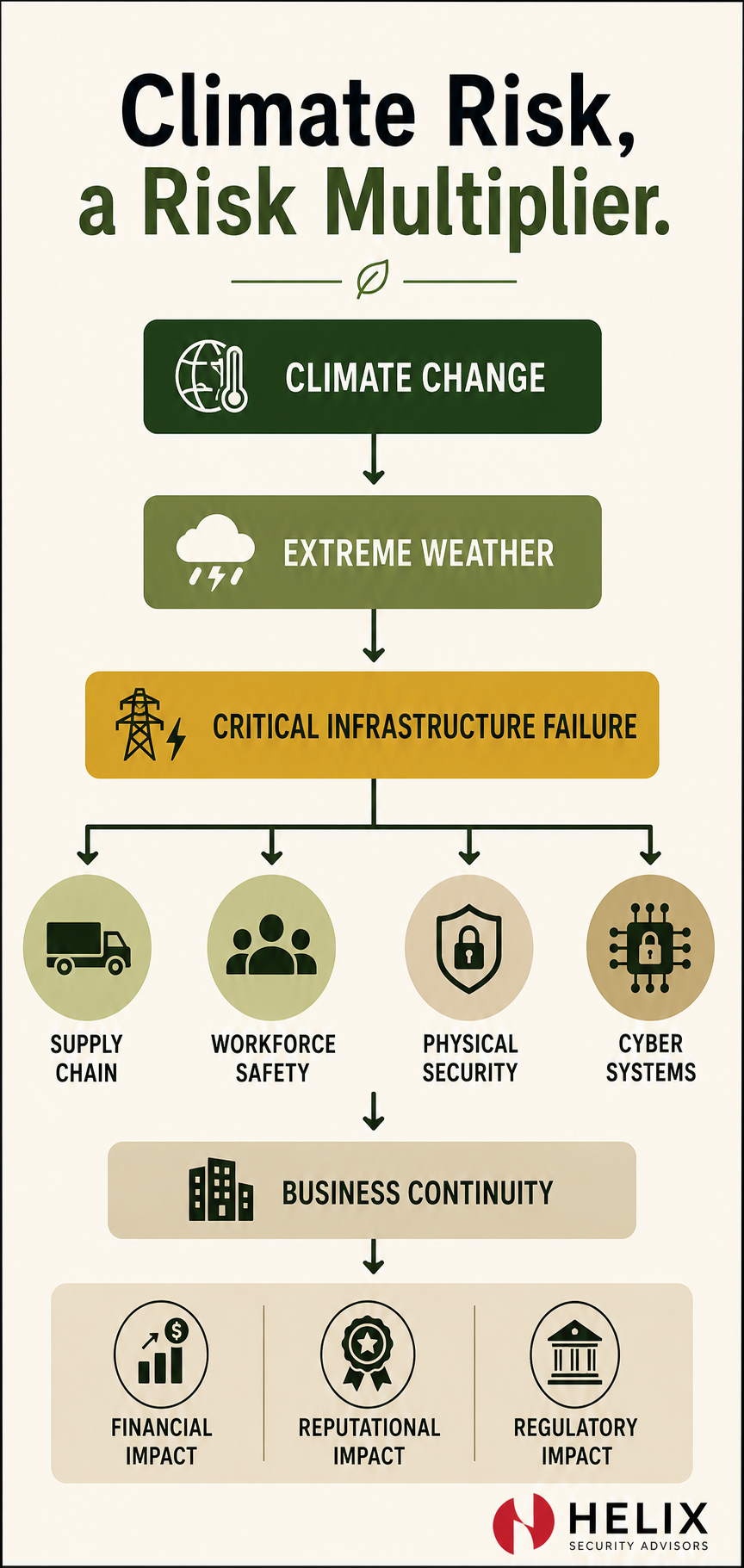
Security Must Evolve From Protection to Resilience - Climate security is not about predicting the next storm. It is about preparing for the cascading failures that follow.
Security leaders have traditionally protected facilities. Tomorrow, they will increasingly be expected to protect operational continuity. That requires thinking beyond perimeter security and integrating physical protection with infrastructure resilience, workforce safety, emergency preparedness and enterprise risk management.
Because the question is no longer:
"Can we prevent every disruption?"
It is:
"How quickly can we absorb disruption, adapt and continue operating?"
Closing Reflection - Throughout The Next Threat Landscape series, I've explored critical infrastructure, data sovereignty, urban security and the convergence of physical and cyber security. Each represents a distinct challenge, yet together they point to a broader reality.
Tomorrow's threats will not arrive one at a time. They will emerge as interconnected, cascading events that test an organization's ability to anticipate, adapt and recover.
Climate change does not replace existing risks—it magnifies them.
For security leaders, the future is no longer defined by stronger walls or smarter technology alone. It will be defined by resilience—the ability to protect people, safeguard critical assets and sustain operations when multiple risks converge.
Disclaimer: The examples referenced in this article are based on publicly available reports and authoritative sources. They are included solely to illustrate how climate-related events can amplify physical security, operational resilience and enterprise risk exposures. The observations and views expressed are intended to stimulate professional discussion and do not constitute investigative findings, attribution of causation or an assessment of any specific organization, government or incident.


Comments