.png)
Data Is the New Terrain: Why Sovereignty Will Define Security Strategy
- Captain Ajesh Sharma (Veteran)

- May 28
- 8 min read
For decades, nations protected sovereignty through geography, military capability, economic strength, and control over critical infrastructure. Today, another strategic terrain has emerged quietly but decisively — data.
Data now powers governments, financial systems, healthcare, telecommunications, transportation, energy networks, supply chains, and increasingly, Artificial Intelligence itself. As a result, the question is no longer only “Is the data secure?” but rather “Who controls the data, where does it reside, and under whose jurisdiction does it ultimately fall?” That is where data sovereignty enters the conversation.
To broaden this discussion, this article also includes insights from industry leader Nikhil Dhand, creator of the Probabilistic Chain Analysis (PCA) Framework, whose work highlights how hidden dependencies and fragmented data ownership can amplify operational and sovereignty risks across modern enterprises.
While data risk today spans virtually every risk vertical, examples from the physical security domain , being the area of my professional expertise , have been used to illustrate the scale and complexity of organizational exposure. The broader objective, however, is to emphasize that every risk function must ensure its operating environment is adequately assessed, governed, and protected for data security and sovereignty perspective.
The Rise of Data Sovereignty : Across the world, governments are strengthening regulations around how personal, sensitive, and critical data is collected, processed, transferred, and stored. The objective is not merely privacy compliance. Increasingly, it is about national resilience, strategic autonomy, and protection against external influence or exploitation.
India’s Digital Personal Data Protection Act (DPDP Act), 2023 is one such example. It establishes obligations around lawful processing of personal data, consent, responsibilities of data fiduciaries, protection obligations, and accountability mechanisms for organizations handling citizen information.
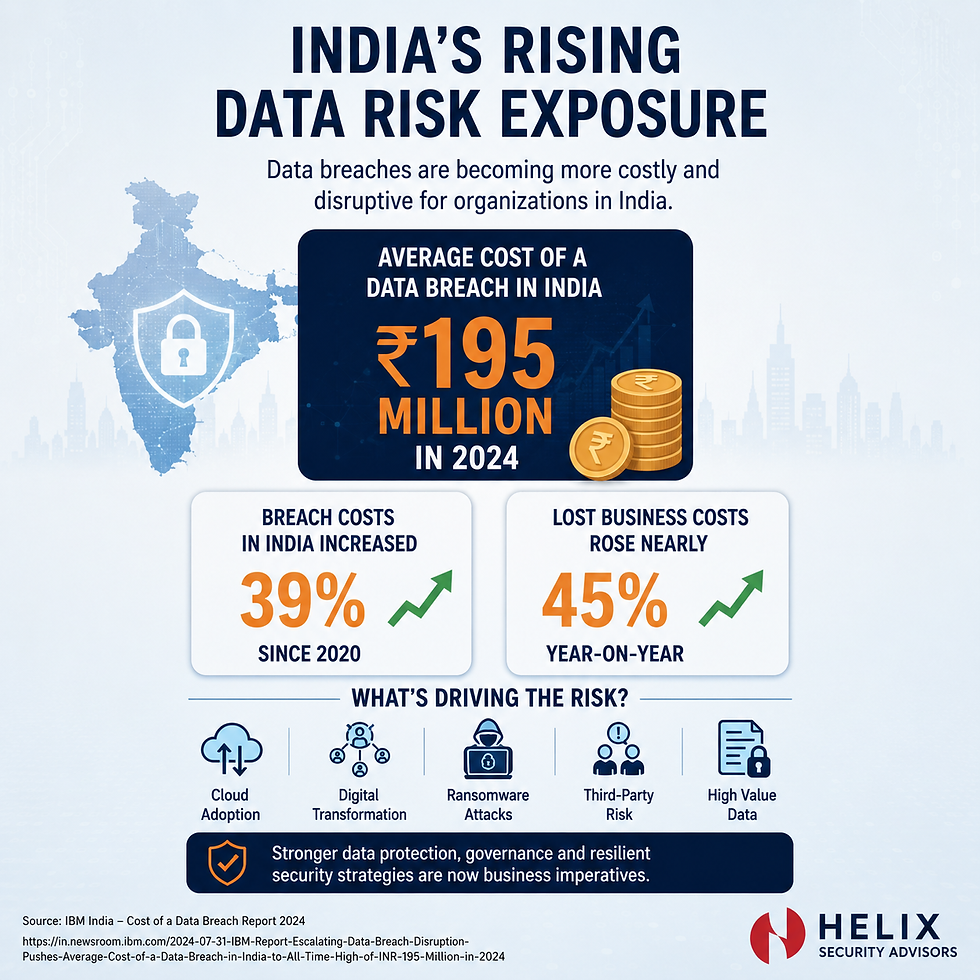
India is not alone.
The European Union’s GDPR, China’s Personal Information Protection Law (PIPL), sectoral regulations in the United States, and multiple emerging frameworks across Asia, the Middle East, and Africa all point toward one clear global trend:
Nations are treating data as a strategic national asset.
As AI ecosystems expand and cloud-based architectures become deeply interconnected across borders, governments are increasingly concerned that uncontrolled movement of sensitive data could create economic, operational, intelligence, or national security vulnerabilities.
When Data Exposure Becomes a Strategic Event : History has already shown how damaging large-scale data exposure can become.
One of the most publicly discussed examples remains the 2017 Equifax breach in the United States, where highly sensitive personal data of approximately 147 million individuals was exposed. The compromised information reportedly included names, Social Security numbers, birth dates, addresses, and other sensitive identifiers. The incident resulted not only in financial losses and regulatory scrutiny, but also raised broader concerns around identity fraud, trust erosion, systemic vulnerability, and long-term exploitation risks associated with compromised personal data.
Two well-known breaches in 2024 — the Change Healthcare cyberattack and the Ticketmaster breach — further demonstrated how evolving digital ecosystems continue to expand organizational data exposure. While the Change Healthcare incident exposed sensitive personal and medical information affecting millions, the Ticketmaster breach reportedly compromised customer data through a third-party cloud environment, highlighting the growing risks associated with interconnected digital supply chains and outsourced technology dependencies.”
The lesson from such incidents is significant - A data breach can rapidly evolve into a governance issue, a reputational crisis, a legal challenge, a strategic vulnerability, and in some cases, a national concern.
Why Governments Are Concerned ?
The scale of global cyber and data-related risk continues to grow at an extraordinary pace.
IBM’s “Cost of a Data Breach Report” has consistently shown that data breaches create multi-million-dollar impacts on organizations globally, with sectors such as critical infrastructure, healthcare, financial services, and public services remaining among the most targeted.
Similarly, global cybercrime damage projections discussed across multiple industry studies indicate potential annual losses running into trillions of dollars worldwide over coming years.
Why does this matter from a sovereignty perspective?
Because modern nations increasingly depend on interconnected digital ecosystems to operate essential services. A compromise affecting telecommunications, ports, energy grids, financial systems, transportation systems, healthcare networks, or identity databases can potentially create cascading national-level consequences.
In effect:
Data compromise can become operational compromise. Operational compromise can become strategic compromise.
That is why governments are no longer viewing data protection purely through the lens of IT security teams. It is becoming a board-level, regulatory, geopolitical, and national resilience issue.

The Overlooked Dimension: Physical Security and Data Sovereignty : One of the most underestimated realities today is that physical security systems themselves have become major generators and carriers of sensitive personal data.
Modern security ecosystems routinely process:
· CCTV footage
· Facial imagery
· Visitor management records
· Biometric authentication data
· Electronic access control logs
· Vehicle movement records
· Intrusion detection events
· Geo-location and movement analytics
· Guard force incident reporting
· Command centre monitoring feeds

Many multinational organizations operate integrated Security Operations Centres (SOCs) or Global Security Command Centres supporting multiple countries simultaneously. In such architectures, security data originating in one country may travel across international networks for centralized monitoring or analytics. This creates important questions that organizations can no longer afford to ignore:
Is personally identifiable information being transferred outside national boundaries?
Is the transfer legally permissible under local data protection laws?
Are CCTV feeds containing facial images being retained in foreign jurisdictions?
Are access control logs revealing employee movement patterns accessible internationally?
Are third-party vendors or cloud providers processing sensitive data outside approved locations?
Is there visibility over who accesses the data and under what authorization?
This is where physical security, cybersecurity, legal, privacy, compliance, HR, and enterprise risk functions must work together rather than operate in silos. In mature environments, organizations increasingly establish technical and governance controls such as:
Segregated network architecture
Data localization controls
Encryption of sensitive security data
Role-based access management
Cross-border transfer approvals
Logging and audit trails
Data minimization practices
Geo-fencing of sensitive systems
Firewall rules restricting unauthorized outbound data movement
Real-time alerts for attempted unauthorized data transfer activity
Continuous monitoring for abnormal data flows
The important point is this: Every risk domain now carries a data protection responsibility within its own operational scope.
Security is no longer only about protecting facilities, systems, or people. It is also about protecting the data generated by those protection systems themselves.
Beyond Cybersecurity: Data Sovereignty as a Dependency Chain Risk - To further broaden the discussion beyond traditional cybersecurity boundaries, I invited industry leader Nikhil Dhand , creator of the Probabilistic Chain Analysis (PCA) Framework, to share his perspective from the world of infrastructure and complex project delivery.
Nikhil explains: “In every large project, data moves across dozens of interfaces — design consultants, survey firms, authority portals, cloud platforms, and government systems. Each handoff carries an assumption: this data is accurate, this system is secure, this vendor is trustworthy. None of those assumptions are formally monitored. None are quantified.”
This insight highlights a growing reality across modern enterprises: Data sovereignty is no longer only a technology or compliance issue. It is increasingly a dependency management challenge.
Nikhil further observes that when data is distributed across multiple platforms, vendors, stakeholders, and jurisdictions, organizations may unknowingly fragment control over critical information assets.
“If you do not understand who controls the data in this modern ecosystem, you do not understand your hidden dependencies.”
This becomes particularly significant in infrastructure programs, engineering ecosystems, and large-scale projects where multiple external entities continuously exchange sensitive operational and project data.
Using the PCA Framework lens, data risk can evolve through cascading operational nodes:
Node Level | The Cascade Event | Impact |
Trigger Node | Data is spread across a government portal, an engineering cloud, and a third-party survey server. | No single party holds sovereignty over the full dataset. |
Node 2: Vendor Trust Failure | The survey firm’s server is breached. Data was not controlled securely. | A trusted dependency collapses silently across downstream systems. |
Node 3: Interface Contamination | Corrupted survey data propagates into the engineering model. | Decisions are now built on a compromised baseline. The assumption "survey data is reliable" was never formally tracked. |
Node 4: Regulatory Exposure | The exposed data sits under multiple conflicting regulatory frameworks. | Legal teams scramble while the project team continues to design using bad data. |
Terminal Node: Delivery Failure | Design must be redone. Approvals stall. The project cost baseline collapses. | The data breach did not just compromise IT—it destroyed schedule, cost, and stakeholder trust. |
What makes this perspective particularly important is that it reframes data governance from a static compliance obligation into a dynamic operational risk environment.
As Nikhil summarizes: “Probabilistic Chain Analysis models risk not as isolated probability scores but as a dependency network, where one failed node triggers a cascade across connected nodes.”
Perhaps the most important takeaway from this perspective is that organizations must stop treating data security as an isolated IT control layer.
Every assumption about:
who owns data,
where it resides,
who can modify it,
how it moves across ecosystems,
and which jurisdiction governs it,
is itself a risk node requiring visibility, governance, and continuous monitoring.
Or as Nikhil succinctly puts it: “Time, Cost and Scope don’t run your project. The risks associated with them do.”
AI Intensifies the Challenge : Artificial Intelligence is rapidly amplifying both opportunity and exposure. AI systems thrive on massive data sets. The larger and richer the data environment, the more powerful the models become. However, this also increases concerns around:
· Unintended data leakage
· Cross-border data ingestion
· Model training on sensitive information
· Shadow AI usage by employees
· Third-party AI platforms processing regulated data
· Automated profiling risks
· Loss of visibility over downstream data usage
Many organizations are adopting AI faster than they are establishing governance mechanisms around how data is collected, classified, transferred, stored, and consumed by AI-driven systems. That gap may become one of the defining enterprise risks of this decade.
The challenge, however, is not unsolvable. Organizations can begin strengthening resilience through several practical and immediately actionable measures.
Low-Hanging Fruit: Immediate Actions Organizations Can Take : Organizations do not need to wait for a major breach or regulatory action to begin strengthening their posture. Some immediate and practical checks include:
1. Map Critical Data Flows
Identify:
· What sensitive data exists
· Where it resides
· Who accesses it
· Which countries it traverses
· Which vendors process it
Many organizations are surprised by how little visibility they actually have.
2. Assess Cross-Border Transfer Exposure - Review whether:
· CCTV data
· Access control logs
· HR records
· Visitor information
· SOC monitoring feeds
are being transferred internationally without adequate governance or approvals.
3. Validate Vendor and Cloud Dependencies - Third-party providers may introduce unseen exposure. Organizations should understand:
· Data hosting locations
· Jurisdictional implications
· Contractual safeguards
· Incident notification obligations
4. Review Access Governance - Conduct immediate checks on:
· Excessive privileged access
· Dormant accounts
· Shared credentials
· Vendor access pathways
5. Test Detection Mechanisms - Organizations should know:
· Whether unauthorized outbound data movement triggers alerts
· Whether monitoring teams can distinguish legitimate vs suspicious transfers
· Whether escalation protocols are clearly defined
6. Conduct Multi-Disciplinary Reviews - Data protection cannot remain isolated within IT or cybersecurity teams alone.
Physical security, legal, compliance, HR, operations, procurement, crisis management, and enterprise risk functions should jointly assess exposure.
Final Thoughts - The next generation of security strategy will not be defined only by perimeter protection, cyber defense, or regulatory compliance. It will increasingly be defined by how effectively organizations understand, govern, protect, localize, and control the movement of data across interconnected ecosystems.
Because in the emerging threat landscape, data is no longer just information.
It is infrastructure
It is influence
It is leverage
And increasingly, it is sovereignty.
As AI-driven environments continue to evolve at extraordinary speed, perhaps the most important question risk professionals should ask themselves is this:
"Are we absolutely certain that every system, process, vendor, platform, and operational function under our remit truly protects sensitive data the way we believe it does , especially when that data may already be moving silently across borders, systems, and AI ecosystems faster than governance frameworks can keep pace?"


Comments