.png)
The Weaponization of Supply Chains: The New Battleground
- Captain Ajesh Sharma (Veteran)

- May 13
- 3 min read
The next major disruption won’t begin with an attack—it will begin with a dependency.
For decades, organizations have treated supply chains as efficiency engines—optimized for cost, speed, and scale. Today, they have quietly become something else: strategic vulnerabilities. From semiconductors to shipping lanes, from cloud infrastructure to critical minerals, dependencies are no longer just operational concerns. They are pressure points—increasingly exposed to disruption, manipulation, and control. We are witnessing a shift. Supply chains are being weaponized.
Beyond Logistics: The New Risk Layer : Traditionally, risk in supply chains meant delays, vendor failures, or cost fluctuations. Now, the risk is far more deliberate.
Access can be restricted
Flow can be disrupted
Dependencies can be leveraged for influence
And often, this happens without a single line of attack code or physical breach.
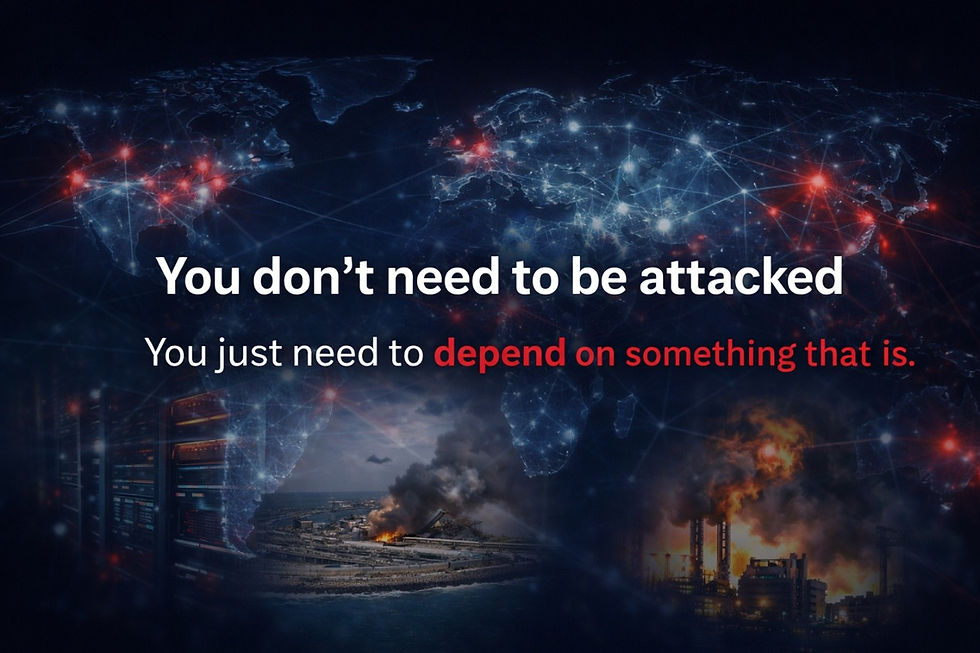
A Different Kind of Threat
From Theory to Reality: When Supply Chains Become Targets. If this still feels abstract, recent events have made it unmistakably real.
In the ongoing Iran–US–Israel conflict, data centres—once seen as neutral infrastructure—have become direct targets.
Drone strikes hit multiple Amazon Web Services (AWS) data centres in the UAE and Bahrain, causing structural damage, power disruption, and widespread outages.
These disruptions impacted financial systems, enterprise platforms, and consumer services across the region—not just the infrastructure itself.
For the first time, hyperscale cloud infrastructure—core to global business operations—was physically attacked in a conflict zone.
This is a fundamental shift.
What organizations believed to be:
Resilient (cloud infrastructure)
Distributed (multi-region systems)
Abstracted from physical risk
…is now being exposed as geographically anchored and physically vulnerable.
And it doesn’t stop there.
Warring nations reportedly identified global tech infrastructure (including AWS, Microsoft, Google) as “legitimate targets,” elevating corporate infrastructure into geopolitical conflict space.
Cyber operations have simultaneously targeted companies, healthcare systems, and surveillance networks, blending physical and digital disruption.
Even desalination plants and energy-linked infrastructure have been struck—highlighting how deeply supply chains are tied to survival systems.
What makes this risk more complex is its subtlety.
There is no alarm.
No visible breach.
No immediate attribution.
Just a gradual realization that what you depend on is no longer fully within your control.
What This Signals
Supply chains are no longer just about movement of goods or services. They now include:
Cloud infrastructure
Data availability
Energy and water dependencies
Digital platforms underpinning operations
And all of these are now within the scope of conflict.
Why This Matters to Organizations
Most organizations still assess supply chains through a procurement or operational lens.
But in today’s environment, that is no longer sufficient. Supply chains now intersect with:
Geopolitical tensions
Regulatory shifts
Infrastructure dependencies
Data and digital ecosystems
This means disruption is not just a business inconvenience—it can become a strategic setback.
Key Questions Leaders Must Start Asking
Do we truly understand our critical dependencies beyond Tier 1 vendors?
Where are we over-concentrated geographically or technologically?
Which dependencies, if disrupted, would halt—not just slow—operations?
Are we building resilience, or just optimizing efficiency?
From Efficiency to Resilience
The operating model needs to evolve. Efficiency made supply chains lean. Resilience will make them survivable.
This requires:
Diversification beyond convenience
Visibility beyond contracts
Strategic thinking beyond quarterly outcomes
In the coming decade, competitive advantage will not just be defined by what organizations can build— But by what they can continue to access when disruption begins.
Because in the new security landscape, control is not about ownership. It is about assured access.
Where do you see the biggest dependency risk in your industry?
Share your thoughts in comments .


Comments